Washer repair in Plano usually costs $130–$350. Most washers that won’t drain, won’t spin or leak need a drain pump, door lock, lid switch, suspension rods or a cleared pump filter. Drum bearings run $400–$900, which is often where replacing makes more sense. The $89 diagnostic is credited toward the repair.
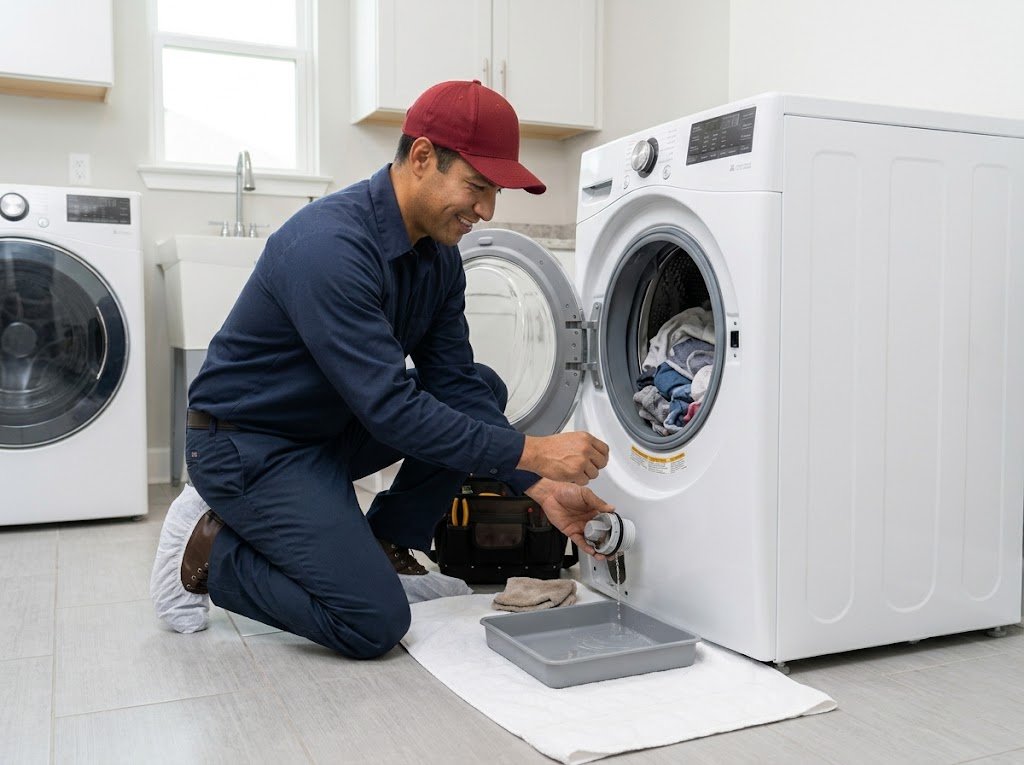
Washer leaking right now? Turn off the hot and cold valves behind the machine, unplug it and don’t start another cycle. Mop up standing water, and if your laundry room is upstairs, check the ceiling below.
A broken washer stops a household fast: wet clothes sitting in the drum, laundry piling up, and sometimes water across the floor. We repair washers across Plano by testing first and replacing second. We check the drain, the door lock, the water level sensor and the fill system before we quote, which is the difference between a cleared filter and a pump nobody needed. You see what failed, you get one price, and you decide.
Washer Repair Service in Plano: What We Fix
Common Washer Problems
| Symptom | Most likely cause | Quick check before you call |
|---|
| Won’t drain | Clogged pump filter (coin trap), kinked drain hose, failed drain pump | Front-load: drain and clean the filter behind the lower panel |
| Won’t spin | Unbalanced load, door lock or lid switch, drive belt, motor or control board | Redistribute the load and run drain/spin |
| Leaking | Torn door boot, loose or cracked fill hose, inlet valve, pump seal | Turn off both valves and stop using it |
| Won’t fill or fills slowly | Scaled inlet valve screens, failed water inlet valve, low pressure | Check both valves are fully open |
| Won’t stop filling | Inlet valve stuck open, pressure switch or water level sensor | Turn off the valves |
| Door won’t lock or unlock | Door lock assembly, water left in the drum, control fault | Run drain/spin, then unplug for 5 minutes |
| Won’t start or stops mid-cycle | Lid or door switch, control board, power supply | Note the error code; don’t keep resetting |
| Musty smell | Residue in the door boot, dispenser and drain | Wipe the boot and run a cleaning cycle |
| Burning smell or tripping breaker | Motor, wiring, control board | Unplug it and call |
What That Noise or Shake Means
| What you notice | Usual cause |
|---|
| Banging or walking on spin | Worn suspension rods or shock absorbers, unlevel feet, shipping bolts left in |
| Grinding or roaring that grows over weeks | Drum bearings and tub seal, often a repair-or-replace decision |
| Humming with no draining | Drain pump jammed by a coin or sock |
| Clicking at start-up | Door lock trying to engage |
| Squeal (belt-drive top-loaders) | Worn belt or motor pulley |
Front-Load Washer Repair
Front-loaders seal water in with a rubber door boot (gasket) and lock the door during the wash. Their common failures are a torn or mildewed boot, a failed door lock, a clogged pump filter (the coin trap behind the lower panel) and worn drum bearings, which show up as a roar on spin and a rust streak behind the drum. Front-loaders are efficient, but they hold residue in the boot, so smell complaints are common.
Top-Load Washer Repair
Top-loaders use an agitator or a low-profile impeller (wash plate). Common faults are a failed lid switch or lid lock (won’t spin), worn suspension rods (heavy shaking), a broken drive belt or coupler, and a stuck water inlet valve. High-efficiency top-loaders sense the load, so a misread pressure switch or an oversized load can make them look broken when they aren’t.
Stacked Washers and Laundry Centers
Stacked units and laundry centers use the same parts in a tighter cabinet, and some need the dryer lifted or the unit pulled out to reach the pump or valves. Tell us it’s stacked when you book so we can plan the access and the time.
How Plano’s Hard Water Affects Your Washer
The City of Plano’s water quality reports show total hardness of up to 312 ppm in 2023 and 202 ppm in 2024 at the NTMWD Wylie treatment plant, roughly 18 and 12 grains per gallon and firmly in the hard range. In a washer, those minerals:
- build up on the inlet valve screens, so the washer fills slowly or not at all;
- leave detergent residue in the door boot and dispenser, which feeds mildew and smells;
- coat the heating element on models that heat water.
Use HE detergent and less of it, and clean the boot and filter regularly. More in our hard water guide.
How Much Does Washer Repair Cost in Plano?
Every visit starts with an $89 diagnostic, credited toward the repair. You get one written price before work: approve it, ask questions, or decline and pay only the diagnostic.
| Repair | Typical total in Plano |
|---|
| Drain pump, hose or filter | $130–$350 |
| Door lock or lid switch | $150–$280 |
| Suspension rods or shock absorbers | $180–$300 |
| Control board | $250–$500 |
| Drum bearings | $400–$900 |
Repair or Replace Your Washer?
| Washer age | Pump, lock, switch, rods, valve | Bearings, motor, board |
|---|
| Under 7 years | Repair | Usually repair |
| 7–12 years | Repair | Compare the quote with a new washer |
| 12+ years | Repair if the tub and drum are sound | Replacement often makes more sense |
A common rule of thumb: if the repair costs more than about half the price of a comparable new washer and the machine is past 10 years old, replace it. See repair or replace.
Front-Load vs Top-Load at a Glance
| Front-load | Top-load |
|---|
| Most common fault | Door boot, door lock, pump filter | Lid switch, suspension rods, belt or coupler |
| Smell risk | Higher (the boot holds moisture) | Lower |
| Bearing failure | More common and costly | Less common |
| Water use | Lower | Higher (agitator models) |
Leaks, Water Damage and Safety
- Shut-off first: know where your washer valves are. Turning both off stops a leak in seconds.
- Hoses: inspect the fill hoses yearly. Replace cracked or bulging rubber hoses; braided hoses still need replacing every few years.
- Upstairs laundry: a slow leak can stain the ceiling below before you notice, so treat any water under the washer as urgent.
- Electrical: unplug before you inspect, and call if the breaker trips or you smell burning.
- Recalls: check your model at CPSC.gov. For example, CPSC recalled about 222,000 GE Profile top-load washers in 2016 over a component that could overheat.
- Children: keep front-load doors closed or child-locked.
How We Repair Your Washer: Our 6-Step Process
- Book. Call or request online. You get an arrival window and a text when we’re on the way.
- Listen. What it’s doing, the last error code (don’t clear it with repeated resets), the load size and the model number from the label.
- Test the full cycle. Fill, wash, drain and spin; door lock, pump and filter, pressure switch, inlet valve, motor and the manufacturer’s diagnostic mode.
- Show and quote. You see the failed part and get one written price, plus an honest repair-or-replace opinion.
- Repair. Common parts are on the truck. We protect your floor while we work.
- Leave it right. We run a full cycle with you watching, hand you the old part and clean up the laundry area.
Why Plano Homeowners Choose Us
- A published price list, with the $89 diagnostic credited to the repair.
- Test first, replace second: a clogged filter is never billed as a new pump.
- Proof, not promises: photos of the failed part and the test results, so you know exactly what you paid for.
- Front-load, top-load, HE and stacked units with OEM or tested-equivalent parts. We tell you which.
Washer Brands We Repair
Samsung, LG, Whirlpool, Maytag, GE and GE Profile, Electrolux, Frigidaire, Bosch, Kenmore, Amana and Speed Queen: front-load, top-load, high-efficiency and stacked laundry centers. The model label is usually inside the door or lid, or on the back panel.
Washer Repair Across Plano
We repair washers in every Plano ZIP (75023, 75024, 75025, 75026, 75074, 75075, 75086, 75093 and 75094), including Legacy West, Willow Bend, Deerfield, Kings Ridge, Lakeside on Preston, Whiffletree, Indian Creek and Downtown Plano. Homeowners, renters and property managers welcome, with tenant coordination and itemized invoices. Dryer acting up too? See dryer repair, or browse our FAQ hub and recent repairs.
