Dryer repair in Plano usually costs $130–$300. A dryer that runs but won’t heat most often needs a thermal fuse, heating element or gas igniter; one that takes two cycles almost always has a blocked vent; squeals and thumps point to the idler pulley, drum rollers or belt. The $89 diagnostic is credited toward the repair.
Smell burning? Stop the dryer, unplug it and don’t run it until it’s checked. Smell gas? Don’t touch switches. Leave the house and call 911 or your gas utility from outside.
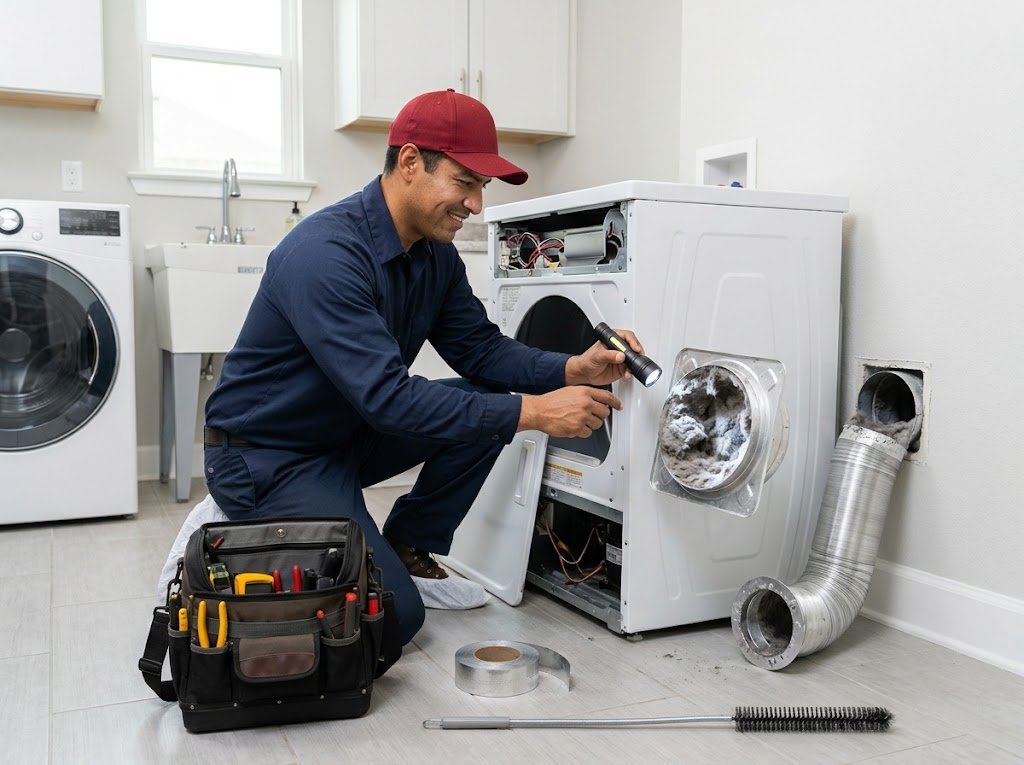
A dryer that won’t dry turns every load into a second cycle, a rack of wet clothes or a laundromat trip, and it’s the home appliance most often involved in house fires. NFPA estimates U.S. fire departments respond to about 15,970 home fires a year involving dryers or washers, and 92% of them involve dryers. We repair dryers across Plano by finding the cause, not just swapping the first part: we test the heat circuit, check airflow from the drum to the outside vent flaps, and show you what failed before you pay for anything.
Dryer Repair Service in Plano: What We Fix
Common Dryer Problems
| Symptom | Most likely cause | Quick check before you call |
|---|
| Runs but no heat | Thermal fuse, heating element (electric), igniter or gas valve coils (gas), high-limit thermostat | Electric: both halves of the 240V breaker must be on |
| Takes two cycles to dry | Lint-packed vent duct, crushed hose, stuck outside vent flaps | Disconnect the duct and run a load. If it dries fast, the vent is blocked |
| Burning smell | Lint near the heater or in the cabinet | Stop using it until cleaned |
| Won’t start | Door switch, thermal fuse, belt switch, start switch | Make sure the door latches firmly |
| Drum won’t turn | Broken drive belt, failed idler pulley, motor | Unplug, then try turning the drum by hand |
| Shuts off early, clothes damp | Moisture sensor coated with fabric-softener residue | Wipe the sensor bars with rubbing alcohol |
| Runs too hot | Cycling thermostat, restricted airflow | Overly hot clothes? Stop and call |
| Won’t turn off | Stuck relay on the control board, timer | Unplug it and book a control check |
What That Noise Means
| Sound | Usual part | Why it matters |
|---|
| High-pitched squeal | Idler pulley | A worn pulley can seize and snap the belt |
| Rhythmic thump | Drum support rollers or a belt flat spot | Worn rollers let the drum drop and rub |
| Scraping | Drum glides or front felt seal | Metal-on-metal can mark clothes and the drum |
| Rumbling or roaring | Rollers, blower wheel, motor bearings | Gets louder over weeks; fix it before the motor goes |
| Clicking (gas) | Igniter cycling, gas valve coils | Ignition fails to finish, so there’s no heat |
Electric Dryer Repair
Electric dryers heat air over a coiled heating element. Power passes through the thermal fuse (a one-time safety cut-out), the high-limit thermostat and the cycling thermostat first; when one opens, the drum still turns but there’s no heat. Overheating is usually the root cause: a blocked duct pushes the temperature up until the fuse blows. That’s why we never replace a thermal fuse without checking the vent, or the new one blows within weeks. Electric dryers run on a 240V circuit, so if only half the breaker trips, the motor runs but nothing heats.
Gas Dryer Repair
Gas dryers use a glow-bar igniter to light the burner, gas valve coils to open the valve and a flame sensor to confirm ignition. The classic failure: the igniter glows, clicks off and no flame appears. That usually means weak valve coils, often an inexpensive fix. If the igniter never glows, it has usually cracked. We test all three before replacing anything and leak-check the gas pipe connection after any gas dryer installation or move. Smell gas? Leave first and call from outside.
Ventless, Condenser and Heat-Pump Dryer Repair
Compact and ventless dryers (common in apartments, stacked laundry closets and newer condos) don’t push air outside. A condenser dryer cools hot, moist air so the moisture turns into water that collects in a tank or drains through a hose, sometimes with a small pump. A heat-pump dryer recycles heat for lower energy use at a lower drying temperature, so slightly longer drying time is normal.
| Ventless problem | Typical cause |
|---|
| Clothes still damp | Lint-clogged condenser, full water tank, blocked filters |
| “Empty tank” or drain error | Kinked drain hose, failed drain pump |
| Water on the floor | Overfull tank, loose drain line |
| Long cycles (heat pump) | Clogged secondary filters, heat-pump fault |
| Steam feature not working | Clogged water inlet, inlet valve |
Most “broken” ventless dryers are clogged ones. Rinse the lint and condenser filters as your manual directs.
How Much Does Dryer Repair Cost in Plano?
Every visit starts with an $89 diagnostic, credited toward the repair. You get one written price for parts and labor before we start. Say yes, ask questions, or decline and pay only the diagnostic.
| Repair | Typical total in Plano |
|---|
| Thermal fuse (plus vent check) | $130–$200 |
| Heating element or gas igniter | $180–$300 |
| Idler pulley, drum rollers or belt | $150–$300 |
| Moisture sensor or door switch | $140–$240 |
Most dryer repairs cost far less than a new dryer plus delivery and haul-away. The exceptions are a failed motor or control board on an older machine. See our pricing page.
Repair or Replace Your Dryer?
| Dryer age | Fuse, element, igniter, belt, rollers | Motor or control board |
|---|
| Under 8 years | Repair | Usually repair |
| 8–13 years | Repair (cheap, long-lasting fixes) | Compare the quote with a new dryer |
| 13+ years | Repair if the drum and cabinet are sound | Replacement often makes more sense |
A common rule of thumb: if the repair is more than about half the price of a comparable new dryer and the unit is near the end of its life, replace it. Dryers are mechanically simple, so most repairs make sense well past ten years. More in repair or replace.
Gas vs Electric Dryer Repairs
| Electric | Gas |
|---|
| Heat source | Heating element | Igniter, gas valve, burner |
| Most common no-heat fix | Thermal fuse or element | Gas valve coils or igniter |
| Power | 240V circuit | 120V outlet plus a gas line |
| Safety extra | Breaker check | Gas leak check after service |
| Shared parts | Belt, rollers, idler pulley, door switch, moisture sensor, thermal fuse | Same |
Vented vs Ventless Dryers
| Vented | Condenser or heat-pump |
|---|
| Where moisture goes | Outside through the duct | Into a water tank or drain |
| Most common slow-dry cause | Blocked vent duct or flaps | Clogged condenser or filters |
| Maintenance | Lint screen every load, duct yearly | Lint and condenser filters, tank or drain |
Dryer Vents, Lint and Fire Safety
NFPA data shows dryers account for most laundry fires, and failure to clean is the leading contributing factor. Lint is the fuel; a blocked vent supplies the heat.
- Every load: empty the lint screen.
- Every few months: wash the screen if fabric softener leaves a film.
- Once a year: have the vent duct cleaned, or sooner if drying time creeps up or the outside flaps don’t open while the dryer runs.
- Use rigid or semi-rigid metal duct; replace thin foil or vinyl hoses and keep the run short with few bends.
- Don’t run the dryer while you’re away or asleep.
We check the vent from the drum to the exterior flaps on every dryer call. Read our dryer vent fire safety guide.
Plano Heat, Humidity and Your Dryer
North Texas summers are hot and often humid, and many Plano homes keep the laundry in a garage or small interior room, so the dryer starts with warm, moist air and a longer path outside. Long, kinked ducts through attics and second-floor laundry rooms restrict airflow further, which means longer drying times and more heat stress on fuses and thermostats. Keep the duct short, clean and straight, and leave room behind the machine.
How We Repair Your Dryer: Our 6-Step Process
- Book. Call or request online. You get an arrival window and a text when we’re on the way.
- Listen. What it’s doing, when it started, gas or electric, any error code, and your model label (inside the door frame or on the back).
- Test in order. Power and breaker, door switch, thermal fuse and thermostats, element or igniter and valve coils, then belt, idler pulley and rollers, then airflow from the drum to the outside vent.
- Show and quote. You see the failed part and get one written price, plus an honest repair-or-replace opinion.
- Repair and clean. Common parts are on the truck; with the dryer open we vacuum lint from the cabinet and blower housing.
- Verify. We run a heated cycle, check temperature and airflow, and give you photo proof of the failed part.
Why Plano Homeowners Choose Us
- Price before work: $89 diagnostic credited to the repair and a published price list.
- The cause, not just the symptom: we never replace a thermal fuse without checking what blew it.
- Vent checked on every call: airflow is the hidden cause of most heat problems.
- Gas, electric, stacked and ventless dryers with OEM or tested-equivalent parts. We tell you which.
- Photo proof of the failed part.
Dryer Brands We Repair
Samsung, LG, Whirlpool, Maytag, GE and GE Profile, Kenmore, Electrolux, Frigidaire, Bosch, KitchenAid, Amana and Speed Queen: gas, electric, stacked laundry centers and ventless models. Find your model label inside the door frame, on the back panel or under the lint-screen lid; a photo helps us bring the right part.
Dryer Repair Across Plano
We repair dryers in every Plano ZIP (75023, 75024, 75025, 75026, 75074, 75075, 75086, 75093 and 75094), including Legacy West, Willow Bend, Deerfield, Kings Ridge, Lakeside on Preston, Gleneagles, Whiffletree, Indian Creek and Downtown Plano. Homeowners, renters and property managers welcome. Washer acting up too? See washer repair.
